EP-RTD50 & EP-RTS50 Rotary Disc Mower Bearing Hub – Compact & Extended Shaft Variants
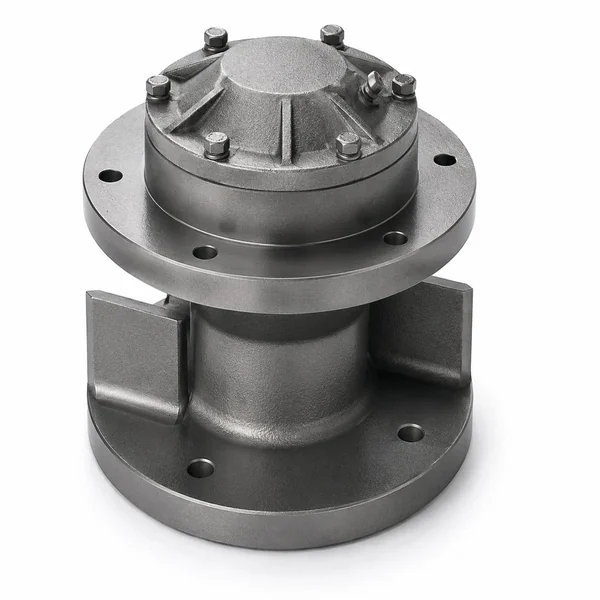
★ Not a Gearbox — A Bearing Hub. The EP-RTD50 & EP-RTS50 Are the Structural Pivot That Every Disc Mower Blade Carrier Spins On
The EP-RTD50 (compact top-flange type, Φ180mm outer, 142mm height) and EP-RTS50 (extended-shaft type, Φ190mm outer, 184mm housing + ~357mm shaft extension, total ~540mm) are heavy-duty bearing hub assemblies for rotary disc mower blade carriers. They carry no gears. They transmit no PTO input. What they do carry — continuously, at blade rotational speeds, under the combined load of blade centrifugal force, grass drag, and intermittent ground contact — is the entire blade carrier assembly. Every disc mower with externally driven blade discs (belt-drive or gear-drive from the deck cross-shaft system) needs a bearing hub at each disc position to support this load. The EP-RTD50 and EP-RTS50 are those hubs. Korea Ever-Power supplies both variants to disc mower OEM manufacturers, mower deck fabricators, and replacement parts distributors across South Korea, Japan, and Southeast Asia.
Bearing Hubs, Not Gearboxes — Understanding the EP-RTD50 & EP-RTS50
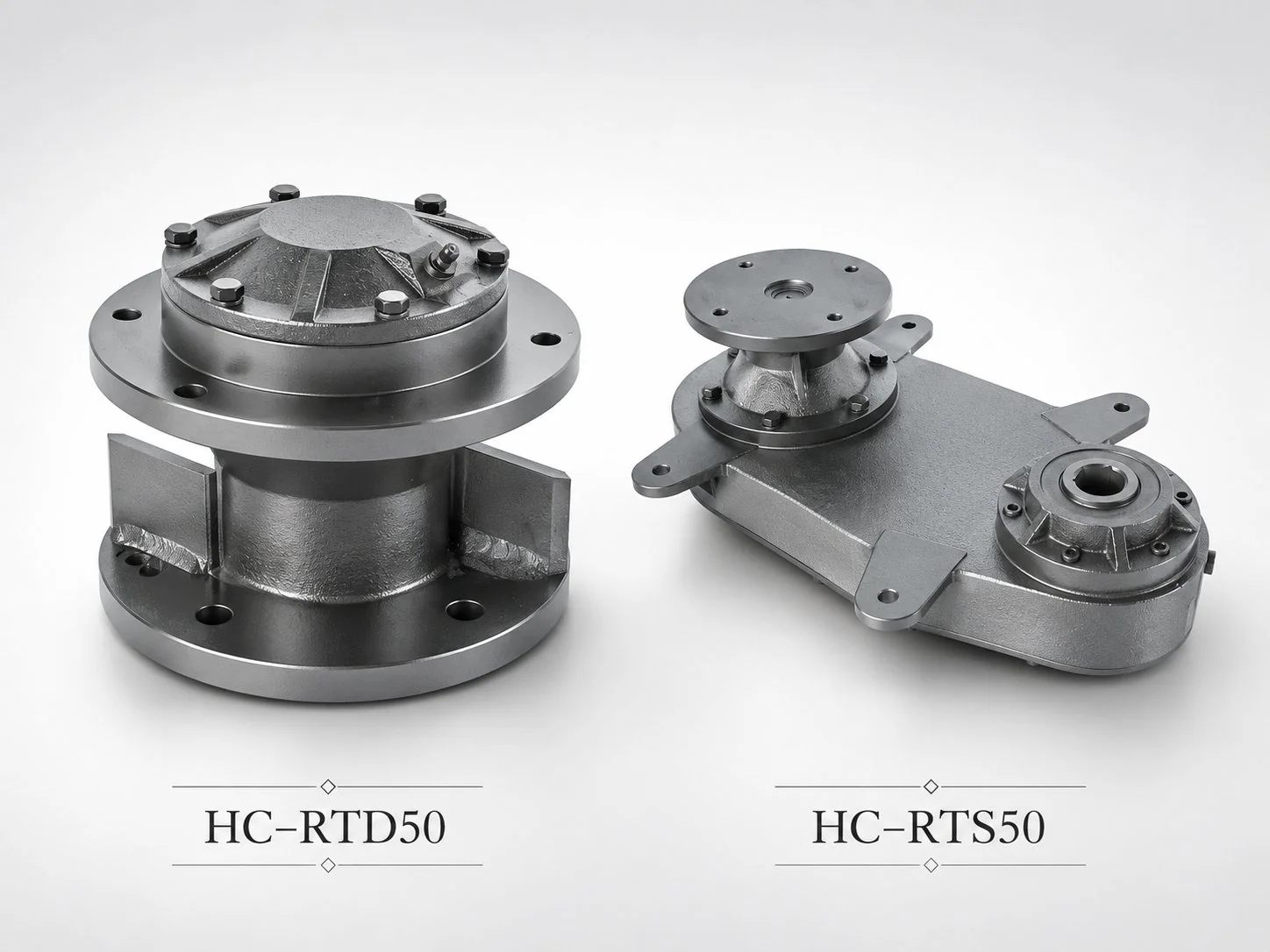
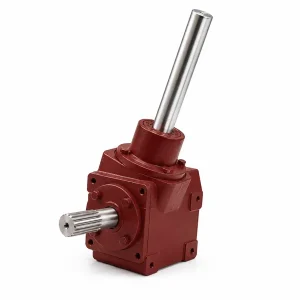
EP-RTD50 (top) · EP-RTS50 (extended shaft) · bearing hub units
Before specifying the EP-RTD50 or EP-RTS50, it is important to understand where they fit in the disc mower architecture — and equally important to understand what they are not.
In a gear-driven disc mower (the more common design in Korean and Japanese agricultural markets), the blade disc is driven through an internal gear set — the EP-MDH-40 or EP-MDH-65 spindle gearbox transmits drive from the deck's cross-shaft to the blade carrier. The EP-MDH unit contains both the drive mechanism and the blade carrier bearings in one assembly.
In a belt-driven or externally-coupled disc mower, the blade disc is driven by a separate mechanism — a belt from an overhead drive pulley, a chain from a cross-shaft sprocket, or a direct coupling from an adjacent gear element that does not pass through the blade hub itself. In this design, the bearing hub at the blade position only needs to provide: structural support for the rotating blade carrier shaft, precision bearing to maintain rotational accuracy, and load capacity to withstand the centrifugal, drag, and impact loads of cutting operation. No internal gear set is needed or present. The EP-RTD50 and EP-RTS50 are exactly this: pure bearing assemblies for blade disc positions that receive their rotational drive from an external source.
A third use case exists where the EP-RTD50 or EP-RTS50 serves as a support bearing for a disc that is directly driven by a separate bevel gear unit beside it — acting as the outboard bearing support for an extended blade shaft whose inboard end is engaged by the drive gearbox. In this configuration, the bearing hub handles the radial and axial loads at the blade carrier end while the gearbox handles the drive at the deck-plate end.
Selection clarity: If your disc mower uses an internal bevel gear at each disc position to transmit drive from the cross-shaft to the blade (the most common Korean and Japanese design), you need the EP-MDH-40 or EP-MDH-65 spindle gearbox — not the EP-RTD50/RTS50. If your disc position uses an external drive mechanism (belt, chain, or separate adjacent gearbox) and only needs a bearing support at the blade carrier, the EP-RTD50 or EP-RTS50 is the correct component. Contact Korea Ever-Power with your mower make and model if you are uncertain which design your machine uses.
Technical Specifications — EP-RTD50 vs EP-RTS50
Like the EP-MDH spindle series, the EP-RTD50 and EP-RTS50 are specified by their mounting flange dimensions, shaft geometry, and blade carrier interface rather than by HP or speed ratio. The key dimensional difference between the two models is the shaft configuration below the flange: the EP-RTD50 is a compact unit with a short blade carrier seat directly below the housing, while the EP-RTS50 has an extended shaft that positions the blade carrier 350+ mm below the mounting flange — creating the cutting height offset needed for specific mower deck designs. 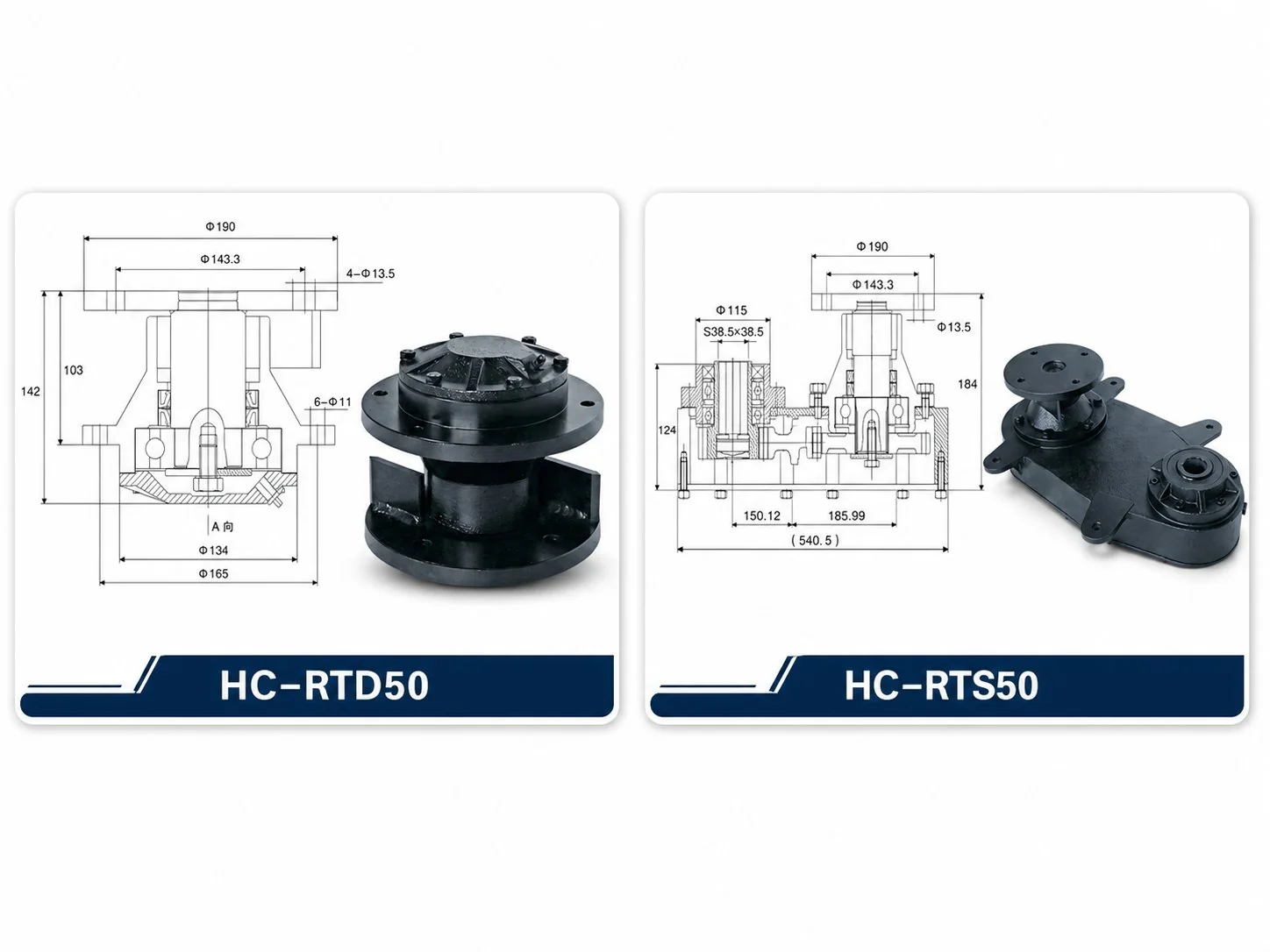
| Parameter | EP-RTD50 | EP-RTS50 |
|---|---|---|
| Unit Type | Compact top-flange bearing hub | Extended-shaft bearing hub |
| Outer Flange Diameter | Φ 180 mm | Φ 190 mm |
| Bolt Circle Diameter | Φ 143.3 mm | Φ 143.3 mm |
| Mounting Bolt Count | 4 × Φ13.5 mm | 4 × Φ13.5 mm |
| Secondary Bolt Holes | 6 × Φ11 mm (blade carrier) | Standard blade carrier holes |
| Blade Carrier Seat OD | Φ 134 mm (inner) / Φ 165 mm (upper) | Φ 115 / Φ 143.3 mm |
| Housing Height | 142 mm | 184 mm |
| Shaft Extension Below Flange | Short — blade carrier close to deck | ≈ 357 mm (total unit ≈ 540 mm) |
| Drive Type | External (belt / chain / adjacent gear) — no internal gearing | |
| Housing Material | Nodular cast iron (GGG50) — both models | |
| Primary Use | Compact mower decks, standard cutting height, close-to-deck blade position | Extended-shaft designs, adjustable cutting height, under-frame clearance applications |
Bearing hub cross-section — shaft extension geometry and flange mounting face
The most striking dimensional difference between the two models is the EP-RTS50's extended shaft. At approximately 540mm total length (184mm housing + ~357mm shaft below), the EP-RTS50 positions the blade carrier nearly 360mm below the deck plate mounting face. This architecture is used in two specific mower design scenarios: first, where the mower deck is mounted high on the tractor's 3-point hitch and the extended shaft brings the cutting plane down to the correct distance above the ground; second, where the mower design places the drive mechanism (belt pulley or chain sprocket) at mid-shaft height and needs a long shaft below it to reach the blade carrier position.
The EP-RTD50's compact geometry (142mm housing, blade carrier close to the flange face) suits mowers where the deck plate itself sets the cutting height and the blade carrier hangs just below the deck. This is the standard arrangement on most Korean compact disc mowers and the simpler construction of European trailed disc mowers. Both units share the same Φ143.3mm bolt circle and Φ13.5mm bolt size, which means both use the same deck-plate bolt pattern — a deliberate dimensional standardisation that allows mower deck manufacturers to use either model without changing the deck plate drilling template.
Bearing Hub vs. Spindle Gearbox — A Practical Engineering Distinction
Understanding the mechanical difference between a bearing hub (EP-RTD50/RTS50) and a spindle gearbox (EP-MDH-40/65) prevents the most common ordering error for disc mower replacement parts. Both assemblies sit at the blade disc position. Both support the blade carrier. But they serve fundamentally different mechanical functions:
| Characteristic | EP-RTD50 / EP-RTS50 (Bearing Hub) | EP-MDH-40 / EP-MDH-65 (Spindle Gearbox) |
|---|---|---|
| Internal Gearing | None — bearing only | Yes — bevel gear set inside |
| Drive Source | External (belt, chain, adjacent gear) | Internal — from deck cross-shaft via bevel gear |
| Gear Oil Required | No — grease only | Yes — SAE 90 gear oil fill |
| Maintenance | Grease nipple only — simpler | Grease + gear oil change |
| Failure Mode | Bearing wear, shaft wear — no gear failure possible | Bearing wear + possible gear failure |
| Identify Your Type | No oil filler plug visible — just grease nipple | Has oil filler plug on housing side |
| Typical Korean Mowers | Trailed disc mowers with overhead belt drive; certain OEM designs from Europe and Korea | Most 3-point hitch mounted disc mowers; standard Korean and Japanese compact mowers |
Quick identification test in the field: Look for an oil filler plug on the side of the blade position housing. If present, it is a spindle gearbox (EP-MDH type) — order the EP-MDH-40 or EP-MDH-65. If the housing has only a grease nipple and no oil plug, it is a bearing hub (EP-RTD50 or EP-RTS50 type) — measure the flange dimensions to determine which variant. The grease nipple versus oil plug distinction is the fastest field diagnostic for this component class.
EP-RTD50 vs EP-RTS50 — The Shaft Length Decision
Both models share the same mounting bolt circle (Φ143.3mm, 4-bolt), so the deck plate receives either model without modification. The choice is determined entirely by the required distance from the deck plate mounting face to the blade carrier position on your mower:
Measurement guide before ordering: With the mower deck parked on level ground, measure the distance from the top of the deck plate (where the bearing hub mounts) to the bottom of the blade carrier assembly. Subtract the thickness of the deck plate (typically 6–10mm). The result is your effective shaft-below-flange dimension. If this is less than 160mm, order EP-RTD50. If it is 300mm or more, order EP-RTS50. For measurements between 160mm and 300mm, contact Korea Ever-Power with the measured dimension — we will advise on the correct variant or whether a custom shaft length is needed.
Construction Quality — What Disc Mower Bearing Hubs Must Withstand
GGG50 Nodular Iron — Impact Rated
The bearing hub housing must absorb the shock loads of blade-to-ground contact and foreign object strikes without fracturing. GGG50 nodular cast iron's elongation-at-break property (18% for GGG50 vs. <1% for grey iron) gives the housing the capacity to deform micro-elastically under shock rather than crack — protecting the bearings and shaft from the catastrophic misalignment that would result from a fractured housing half.
Heavy-Duty Tapered Roller Bearings
The EP-RTD50 and EP-RTS50 use tapered roller bearings rather than ball bearings at both the upper and lower shaft positions. Tapered rollers handle the combination of radial load (blade centrifugal force) and axial load (blade weight and vertical shock) more effectively than ball bearings at the blade disc loads typical of compact and mid-size mower decks. The tapered design also allows the bearing pre-load to be adjusted at assembly — a precision step that determines the shaft's running clearance and, consequently, blade carrier runout.
Multi-Layer Lower Seal
The lower shaft exit — where the blade carrier attaches — is the highest contamination-risk zone on the bearing hub. Grass fibres wrapping the rotating shaft at speed are the primary seal destroyer in disc mower bearing hubs. The EP-RTD50 and EP-RTS50 use a multi-layer sealing arrangement: a primary lip seal, a secondary dust exclusion ring, and a scraper profile at the shaft exit that deflects grass fibre wrap before it reaches the seal lips. This three-layer approach is standard on heavy-duty European disc mower bearing hubs and is reflected in the EP-RTD50/RTS50 design.
Shared Bolt Circle — Same Deck Template
Both EP-RTD50 and EP-RTS50 use the same Φ143.3mm bolt circle with 4-Φ13.5mm mounting bolts. This shared bolt pattern allows a mower deck manufacturer to drill one template for both models — using EP-RTD50 on positions where a compact shaft is required and EP-RTS50 on positions where extended reach is needed, without any deck plate modification. It also allows one model to replace the other in field repair situations where only the shaft length differs from the original specification.
Surface-Hardened Blade Carrier Shaft
The blade carrier shaft is surface-hardened at the blade disc mounting seat, the lock ring groove, and the lower bearing contact surface — the three zones of highest fretting wear in bearing hub service. The hardening is induction-targeted rather than through-hardened, preserving the core toughness needed to withstand impact loading while providing the surface hardness to resist fretting and abrasive wear from the fit between the blade carrier bore and shaft surface.
Runout-Verified Before Dispatch
As with the EP-MDH spindle series, every EP-RTD50 and EP-RTS50 unit is checked for blade carrier shaft runout using a dial indicator before packaging. Maximum allowable runout is 0.05mm TIR at the blade carrier seat location. Units outside this limit are rebuilt before dispatch — no exceptions, regardless of production pressure. Shaft runout above this limit is directly perceptible as disc vibration at blade speeds and creates cyclic bearing loading that shortens bearing life.
Where EP-RTD50 & EP-RTS50 Are Used
🌿 Trailed Disc Mower Decks — Korea & Japan Forage Production
Trailed (pull-behind) disc mower-conditioners used in Korean Gangwon and Gyeongbuk forage operations and Japanese Hokkaido dairy farm hay production typically carry 4–6 blade disc positions driven via a belt or chain system from a central PTO-input gearbox running along the deck frame. At each disc position in this design, the EP-RTD50 or EP-RTS50 provides the blade carrier support — the drive comes from the belt or chain, and the bearing hub carries the structural and rotational load. The EP-RTS50's extended shaft is commonly used in Korean trailed mower designs where the blade must clear the structural frame members between the mowing platform and the cutting plane.
🏭 OEM Disc Mower Deck Manufacturing — Korea
Korean disc mower deck manufacturers building both 3-point hitch and trailed models for domestic sale and export specify the EP-RTD50 and EP-RTS50 across their product lines. The shared Φ143.3mm bolt circle between the two models is specifically valued in OEM production: one jig, one drill template, two shaft-length options. This manufacturing simplification reduces tooling cost and allows the OEM to offer cutting height variants (compact vs. extended) as a single-number part change rather than a complete deck redesign. Korea Ever-Power supplies OEM customers with dimensional certification and volume pricing on both EP-RTD50 and EP-RTS50.
🔧 Aftermarket Replacement — European Disc Mower Brands
Korean and Japanese agricultural workshops servicing European-brand trailed disc mowers (Krone, Claas, New Holland, Kuhn) frequently need bearing hub replacements for the non-gearbox disc positions on these machines. The EP-RTD50 and EP-RTS50 dimensional specifications — particularly the Φ143.3mm bolt circle and Φ13.5mm bolt size — correspond to widely used European bearing hub standards. Korea Ever-Power can provide dimensional drawings for pre-order compatibility verification. As with all EP series products used as aftermarket replacements, the OEM brand is not affiliated with Korea Ever-Power and all model references are provided for specification matching only.
🌾 Extended-Reach Orchard & Vineyard Mower Applications
Some Korean orchard and Japanese vineyard disc mower designs mount the cutting deck at waist height for ergonomic operator access while requiring the cutting plane to be at ground level — creating a requirement for an extended shaft between the deck mounting structure and the blade carrier. The EP-RTS50's approximately 540mm total length (184mm housing + ~357mm shaft) is used in these extended-reach designs, where the drive comes from an overhead belt system and the shaft length determines the cutting height. Korea Ever-Power's technical team can advise on shaft length selection for specific orchard mower frame dimensions upon enquiry.
Maintenance & Failure Diagnosis — Bearing Hubs in Disc Mower Service
Bearing hub maintenance is simpler than spindle gearbox maintenance — no oil changes, no gear oil level checks. But the grease interval and seal condition are even more critical because the bearing hub has no oil reservoir to buffer the effect of a momentary lubrication shortfall:
📋 Grease Schedule — Every 50 Hours
Use NLGI No.2 lithium complex grease, two pump strokes per 50 operating hours at the Zerk fitting. Over-greasing is counterproductive — excess grease in the bearing cavity heats and breaks down, creating a semi-solid plug that displaces fresh grease and prevents proper bearing lubrication. Two strokes at the correct 50-hour interval is more effective than four strokes at 100 hours.
⚠️ Shaft Play — The Primary Warning Sign
Grasping the stationary blade carrier and rocking it laterally: more than 1–2mm of movement indicates bearing play requiring replacement. Unlike spindle gearboxes where gear noise often precedes bearing failure, bearing hubs fail more quietly — the first audible sign is often a low, cyclic rumble at slow PTO speed that disappears at operating speed. Do not wait for the audible signal; rely on the physical play check at each 50-hour service.
⚠️ Grass Wrap on Lower Shaft
Accumulated grass fibre wrap on the lower shaft — visible as a tight, layered ring of compacted fibres around the shaft just above the blade carrier — is the warning sign of seal damage in progress. The fibre wrap accelerates by forcing itself into the seal gap on each revolution. Remove grass wrap at every 50-hour inspection, never cut it with a blade (risk of shaft scoring) — pull it off by hand with the machine fully stopped.
📋 EP-RTS50 Extended Shaft — Additional Check
The EP-RTS50's extended shaft is more susceptible to bending deflection from lateral ground contact than the compact EP-RTD50. At each seasonal inspection, sight along the shaft from above with the blade carrier removed — visible curvature of more than 1mm over the shaft length indicates a bending event that may have damaged the lower bearing. Bent shafts must be replaced — do not attempt to straighten a bearing hub shaft in the field.
Why Korea Ever-Power for Disc Mower Bearing Hubs
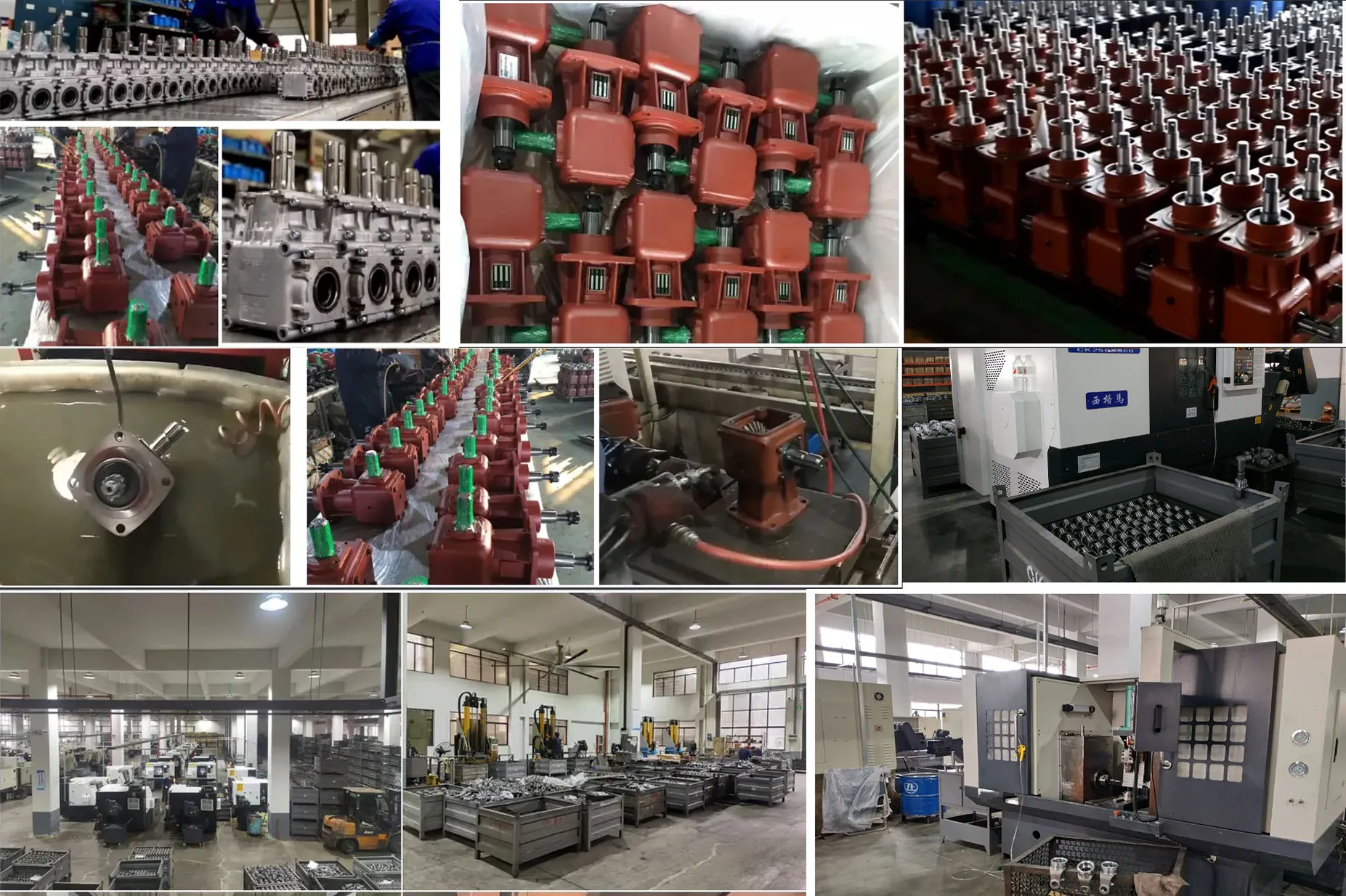
Precision shaft turning and bearing seat machining — same facility as EP series gearboxes
The EP-RTD50 and EP-RTS50 are produced at Korea Ever-Power's 3,800 m² facility alongside the EP-MDH spindle series and the full HC bevel gearbox range — using the same CNC turning equipment, the same bearing seat tolerance standards, and the same pre-dispatch runout inspection procedure. This production integration means the bearing hub quality management process is not a separate, lower-priority workflow; it receives the same engineering attention as the gearbox product lines.
Korea Ever-Power Agricultural Machinery Co., Ltd. maintains regional stock of both EP-RTD50 and EP-RTS50 for 3–5 business day delivery to South Korea and Japan, and 5–7 days to Southeast Asia. No minimum order quantity — single replacement units are supplied with the same documentation as OEM batch orders. Complete export documentation is prepared for every shipment, supporting customs clearance under RCEP and applicable ASEAN preferential tariff agreements.
Complete Your Disc Mower Drive System
What Customers Say About the EP-RTD50 & EP-RTS50
Frequently Asked Questions — EP-RTD50 & EP-RTS50
Additional information
| Editor | Cxm |
|---|
Related products
-
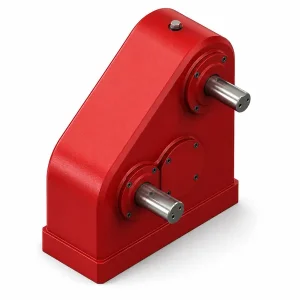
EP-FRM70 Residual Film Recovery Gearbox — 40 to 70 KW, Dual-Mode Reduction and Speed Increase
-
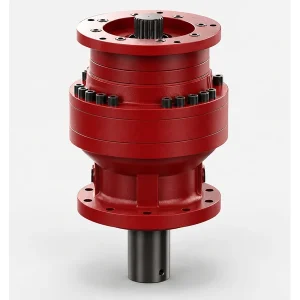
EP-PGR60 Planetary Gear Reducer — 60 KW, 12.41:1 Ratio for Electric Motor Drive
-
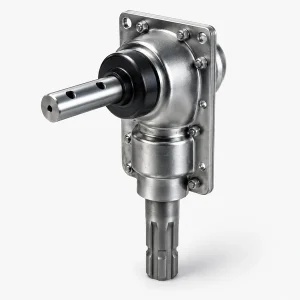
EP-01-229 Aluminum Gearbox & EP-1ZS-380 Triple-Shaft Bevel Gearbox – Special Application Series
-
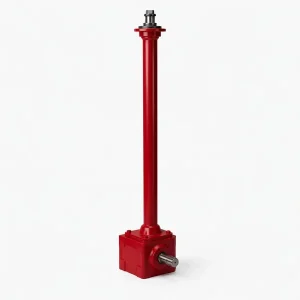
EP20100.131.00 Agricultural Drive Gearbox – 100HP, 13:1 Reduction, 600RPM, 8-Bolt Flange
-
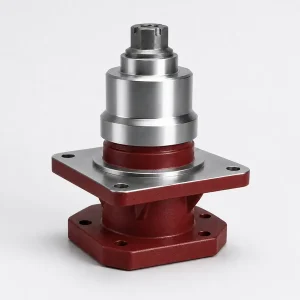
EP-MDH Vertical Shaft Mower Spindle Gearbox – MDH-40 (Square Flange) & MDH-65 (Hex Flange)
-
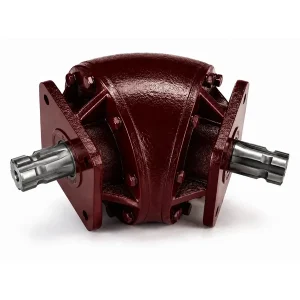
EP-AG135 Fertilizer Spreader Gearbox – 50HP, 45° Dual Output, Twin-Disc Drive
-
EP-HC-68 Degree Angle Gearbox – 30HP 68° Shaft Angle, 1:1 Ratio PTO Drive
-
EP-HC-40002 Round Baler Gearbox – 85HP Heavy Duty