
Boîte de vitesses pour épandeur d'engrais EP-AG135 – 50 CV, double sortie à 45°, entraînement par double disque
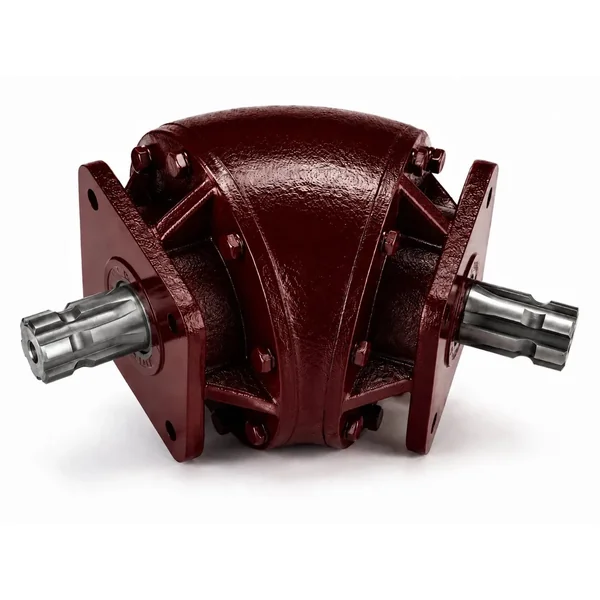
★ Parfaitement égal. Parfaitement simultané. — La boîte de vitesses de l'épandeur d'engrais à double disque de 50 CV est conçue pour une distribution uniforme.
Le EP-AG135 Il entraîne les deux disques d'un épandeur d'engrais à double disque à partir d'une seule prise de force — de manière égale, simultanée et à la même vitesse. Sortie symétrique double à 45° La disposition (entraxe de 297 mm entre les deux arbres de sortie) délivre un couple identique à chaque rotor de disque grâce à des arbres cannelés à base conique appariés, garantissant ainsi que les vitesses de rotation des disques gauche et droit ne divergent jamais et que le débit d'application reste constant sur toute la largeur de travail, passage après passage. 50 ch, 540 tr/min, rapport de transmission 1:1, Module 6.0, jeu d'engrenages coniques symétriques 20/20 dents, 16,5 kg Carter en fonte nodulaire. Fourni par Korea Ever-Power Agricultural Machinery Co., Ltd. aux fabricants d'épandeurs d'engrais, aux distributeurs de machines agricoles et aux coopératives agricoles en Corée du Sud, au Japon et en Asie du Sud-Est.
L'EP-AG135 — Conçu spécifiquement pour une précision optimale des épandeurs d'engrais à double disque
EP-AG135 · 50 ch · Rapport de compression 1:1 · Double sortie à 45° · 16,5 kg
L'argument agronomique en faveur d'une répartition uniforme des engrais est bien établi : une application irrégulière sur la largeur de travail engendre des zones de culture sur- et sous-fertilisées, visibles à la récolte et mesurables dans les données de rendement. Dans un épandeur à double disque, le réducteur est le composant en amont le plus directement responsable de l'uniformité de la vitesse des disques ; si un disque reçoit plus de couple que l'autre, il tourne plus vite, projette l'engrais plus latéralement et crée une asymétrie latérale que l'agronome attribuera au réglage de l'épandeur plutôt qu'au champ.
La conception de l'EP-AG135 répond directement à cette problématique. Le train d'engrenages symétrique 20/20 avec module M6.0 est placé au centre du carter, recevant le couple de la prise de force via une unique entrée Z6 de 1 3/8″ et le distribuant à deux arbres de sortie inclinés à 45° par rapport à l'axe d'entrée et espacés symétriquement de 297 mm d'axe en axe. Comme les deux arbres de sortie sont entraînés par le même train d'engrenages, sans différentiel ni embrayage intermédiaire, ils ne peuvent physiquement pas tourner à des vitesses différentes en régime permanent. Toute variation de couple entre la gauche et la droite, due à un déséquilibre des disques, à des différences de charge ou à l'usure des palettes, est absorbée comme une variation de la charge d'engrènement, et non comme une différence de vitesse : le mécanisme assure ainsi une synchronisation cinématique.
L'angle d'arbre de 45° ne pose pas le même problème géométrique que pour l'unité EP-68°. Ici, cet angle de 45° a une fonction totalement différente : il positionne les deux arbres de sortie de manière à ce que chacun entraîne son rotor à disque selon un angle assurant la trajectoire d'éjection optimale pour la géométrie standard des épandeurs à double disque. L'angle de 45° entre l'arbre d'entrée et chaque arbre de sortie est symétrique, ce qui signifie que le carter possède un axe de symétrie bilatérale parfait. Cette caractéristique de conception simplifie le montage, garantit une longueur d'arbre identique entre le carter et chaque disque, et offre au fabricant d'épandeurs une structure de machine géométriquement équilibrée sans compensation supplémentaire du châssis.
Référence de remplacement : L'EP-AG135 est conçu comme un remplacement direct des boîtes de vitesses d'épandeurs d'engrais à double disque OEM comparables Rauch, Amazone, Kuhn et Vicon dans la classe de double sortie 50 CV / 1:1 / 45°. Korea Ever-Power n'est ni affiliée à, ni sponsorisée par, ni un distributeur agréé de pièces détachées pour ces marques. Les références de modèles sont fournies uniquement pour aider les clients à identifier les spécifications de remplacement compatibles.
Spécifications techniques
Tous les paramètres sont vérifiés en usine à partir de la fiche technique officielle du produit EP-AG135. Le nombre de dents symétrique 20/20 confirme un rapport de 1:1 : les deux arbres de sortie tournent exactement à 540 tr/min lorsque la prise de force atteint 540 tr/min. Le module 6.0 de cette unité de 50 ch utilise un pas de dent plus grand que celui de l’EP-68° (M4.23 à 30 ch) car l’EP-AG135 répartit le couple sur deux arbres de sortie simultanément. Bien que chaque arbre de sortie ne supporte que la moitié du couple d’entrée total à un instant donné, le train d’engrenages doit être dimensionné pour la charge simultanée combinée, et non pour la seule contribution d’un arbre.
| Paramètre | Valeur | Notes techniques |
|---|---|---|
| Modèle | EP-AG135 | Série Applications Spéciales — Entraînement d'épandeur d'engrais à double disque |
| Angle de l'arbre de sortie | 45° (dual symétrique) | Les deux sorties sont à 45° de l'axe d'entrée de la prise de force — symétriques par rapport à l'axe du carter. |
| Rapport de vitesse | 1 : 1 | Vitesse identique sur les deux sorties — aucune réduction ni augmentation |
| Nombre de dents | 20 / 20 | Symétrique — charge d'engagement des dents égale des deux côtés de sortie |
| Module d'engrenage | 6.0 | Dimensionné pour une charge de couple combinée à double sortie de 50 ch |
| Puissance nominale | 50 CV | ≈ 37,3 kW en continu — répartis équitablement entre deux sorties |
| Vitesse d'entrée nominale | 540 tr/min | Vitesse de prise de force standard des tracteurs agricoles |
| Arbre d'entrée | Cannelure Z6 de 1 3/8″ | Prise de force conforme à la norme ISO 500 |
| Arbres de sortie (×2) | spline équilate à base conique | Les deux arbres sont identiques — interface de moyeu de disque d'épandage standard |
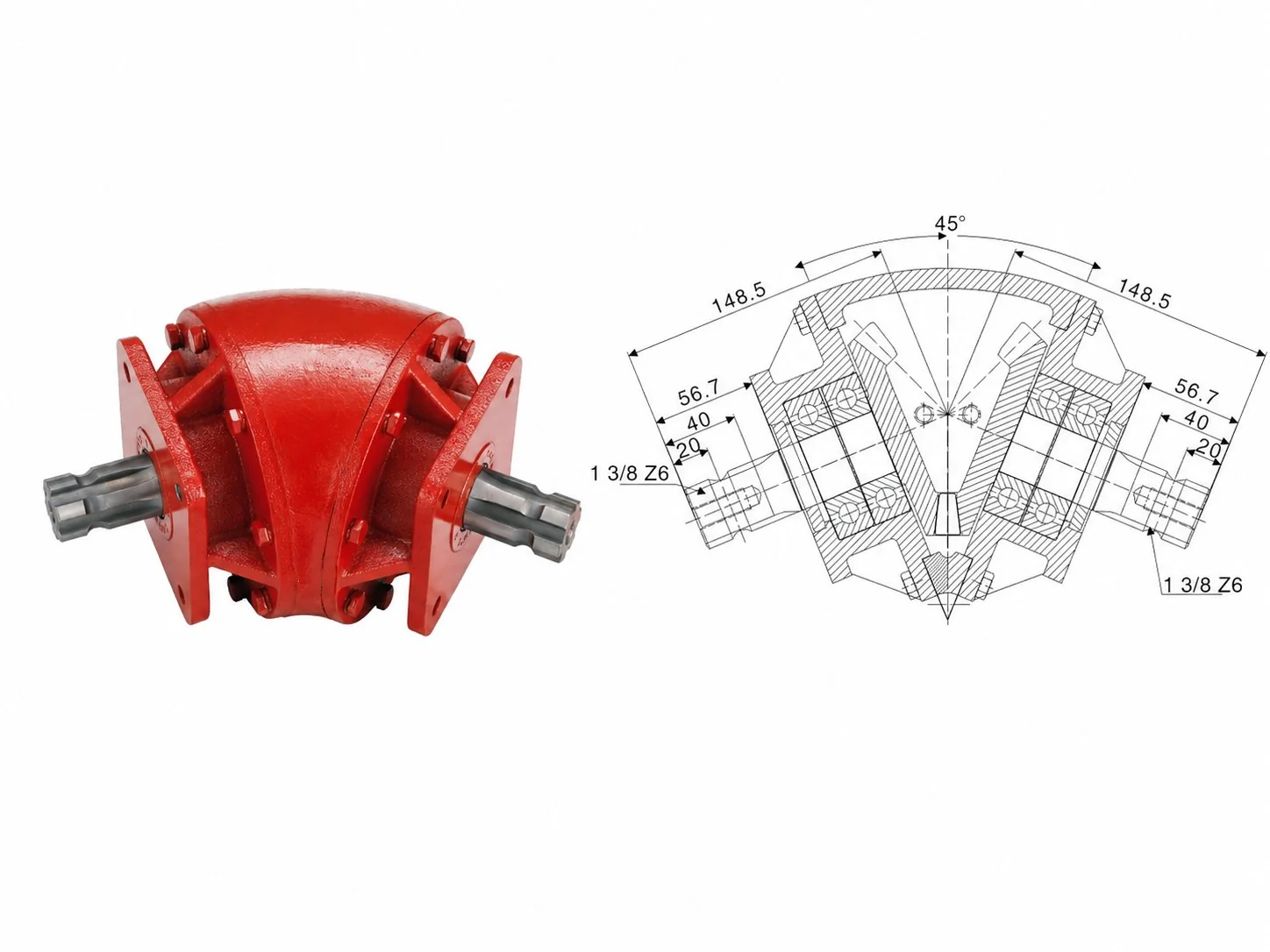
| Espacement de l'arbre de sortie | 297 mm d'axe en axe | D'après le plan technique : 148,5 mm de chaque côté de l'axe du boîtier |
| Matériau du boîtier | Fonte nodulaire (GGG50) | Moulage symétrique — rigidité égale des deux côtés de l'arbre de sortie |
| Poids net | 16,5 kg | Compact pour 50 CV — intégration du châssis de l'épandeur à double disque |
La lecture du schéma technique de la fiche technique originale permet de préciser la géométrie de l'EP-AG135 : le carter mesure 297 mm de diamètre sur toute la longueur de l'arbre de sortie (148,5 mm de l'axe central à chaque sortie), chaque arbre de sortie formant un angle de 45° avec l'axe d'entrée de la prise de force, cette dernière étant insérée par le haut. La distance de 56,7 mm entre la face du carter et l'axe de chaque arbre de sortie confirme la symétrie : les deux arbres sont à égale distance de la face du carter, ce qui garantit une longueur d'arbre libre identique jusqu'à chaque moyeu de disque et un moment de flexion identique sous la charge du disque.
L'arbre d'entrée de la prise de force est situé au centre supérieur du carter, avec une cannelure Z6 de 1 3/8″ insérée verticalement (ou selon l'angle de montage du châssis de l'épandeur). Les deux arbres de sortie sont disposés symétriquement à 45° de chaque côté, formant une configuration caractéristique en « Y » ou en « V » vue de dessus — la configuration la plus compacte et équilibrée pour une transmission à double disque. L'extrémité de sortie à cannelure équidistante à base conique des deux arbres correspond à l'interface standard du moyeu de disque utilisée sur les principaux épandeurs à double disque européens, ce qui fait de l'EP-AG135 un remplacement direct sur la plupart des plateformes d'épandeurs courantes.
Pourquoi la double sortie synchrone est le fondement de la précision de l'épandeur
La précision d'épandage d'engrais avec les épandeurs à double disque dépend de trois facteurs : la vitesse des disques, l'angle des pales et le débit d'alimentation. La boîte de vitesses contrôle la vitesse des disques ; si cette vitesse diffère entre les disques gauche et droit, les courbes d'étalonnage de l'épandeur (qui supposent une vitesse de disque identique) deviennent invalides, ce qui engendre une répartition asymétrique systématique qui se modifie à chaque cycle de charge en fonction de l'usure des disques et de la densité de l'engrais.
Verrouillage cinématique de la vitesse — Non électronique
L'engrenage unique de l'EP-AG135 entraîne simultanément les deux sorties grâce à un seul engrènement. Il s'agit d'un verrouillage cinématique de la vitesse : les deux arbres sont mécaniquement contraints à la même rotation par rapport à l'engrenage d'entrée. Contrairement aux systèmes électroniques de synchronisation de vitesse qui corrigent les différences de vitesse a posteriori, la conception à engrenage unique empêche toute différence de vitesse dès le départ. Aucun capteur, aucun contrôleur, aucune dérive d'étalonnage. La physique de l'engrènement partagé garantit la synchronisation à chaque tour.
Géométrie symétrique — Portée de tige égale
Le carter symétrique de 148,5 mm de chaque côté positionne les deux arbres de sortie à égale distance de l'axe central du carter. Il en résulte une longueur d'arbre identique entre le réducteur et chaque moyeu de disque, une distance identique entre le palier et le disque, et une inertie de rotation identique de chaque côté. Lorsqu'un disque reçoit une charge d'engrais plus importante que l'autre — ce qui arrive inévitablement en raison des variations de granulométrie et de l'asymétrie du débit dans la trémie — la géométrie mécanique identique garantit une réponse du couple identique et une différence de vitesse nulle.
Schéma de lancer constant — Chaque passe
Le schéma d'épandage d'un épandeur à double disque est calibré une seule fois par type de produit à l'aide du tableau d'épandage du fabricant. Ce calibrage suppose une vitesse de disque constante tout au long de l'application. Avec un entraînement synchrone des disques, le schéma d'épandage est identique du premier au cinquantième passage, que la trémie soit pleine ou presque vide, et que la culture soit dressée ou couchée. Cette répétabilité permet une application à dose variable précise sur les épandeurs équipés d'un système ISOBUS, où le contrôleur ajuste l'ouverture des vannes tout en supposant une vitesse de disque constante.
Note agronomique à l'intention des céréaliers coréens et japonais : Les programmes de subventions à l'agriculture de précision du gouvernement coréen et l'initiative japonaise pour une agriculture intelligente mettent tous deux l'accent sur l'efficacité de l'utilisation des intrants, les engrais représentant le principal poste de dépenses variables dans la production de riz, d'orge et de légumes. La démonstration de doses d'application uniformes, grâce à des données d'épandage calibrées, est de plus en plus exigée pour le maintien des subventions. Un réducteur assurant la synchronisation de la vitesse des disques simplifie cette démonstration, car la répartition est mécaniquement constante plutôt que corrigée électroniquement.
Pourquoi 45° ? — La géométrie du lancer à double disque
L'angle de 45° de l'arbre de sortie n'est ni un choix esthétique ni une facilité de fabrication ; il résulte de l'optimisation de la géométrie de montage du disque sur le châssis pour la configuration standard d'épandage à deux disques. Comprendre pourquoi cet angle de 45° est approprié ici nécessite d'analyser la relation entre l'angle de l'arbre du disque et la répartition du matériau :
EP-AG135 vs. EP-68° — Choisir le bon réducteur d'angle
Korea Ever-Power produit deux réducteurs agricoles à angle non droit. Ils partagent le principe d'une disposition d'arbre non à 90°, mais sont destinés à des catégories d'application totalement différentes et ne doivent pas être confondus.
| Facteur | EP-AG135 (ce produit) | EP-68° |
|---|---|---|
| Angle de l'arbre | 45° — duale symétrique | 68° — sortie unique |
| Nombre de sorties | Deux (gauche + droite, égaux) | Un |
| Puissance nominale | 50 CV | 30 CV |
| Module d'engrenage | M6.0 (série standard) | M4.23 (personnalisé pour 68°) |
| Poids net | 16,5 kg | 13,2 kg |
| Application principale | Épandeurs d'engrais à double disque nécessitant une double transmission symétrique | Outils à cadre incliné nécessitant un entraînement unique non à angle droit |
| Interface de sortie | Spline équilate à base conique (les deux) | Spline (simple) |
Si votre application nécessite une seule sortie à angle non droit, consultez la section EP-68° Page produit. Si votre système à double rotor nécessite deux sorties à vitesse égale, le modèle EP-AG135 est adapté. Contactez Korea Ever-Power si votre configuration à double sortie implique un angle d'arbre différent ou un rapport autre que 1:1 ; des spécifications personnalisées sont disponibles pour les commandes importantes.
Qualité de la construction et des matériaux
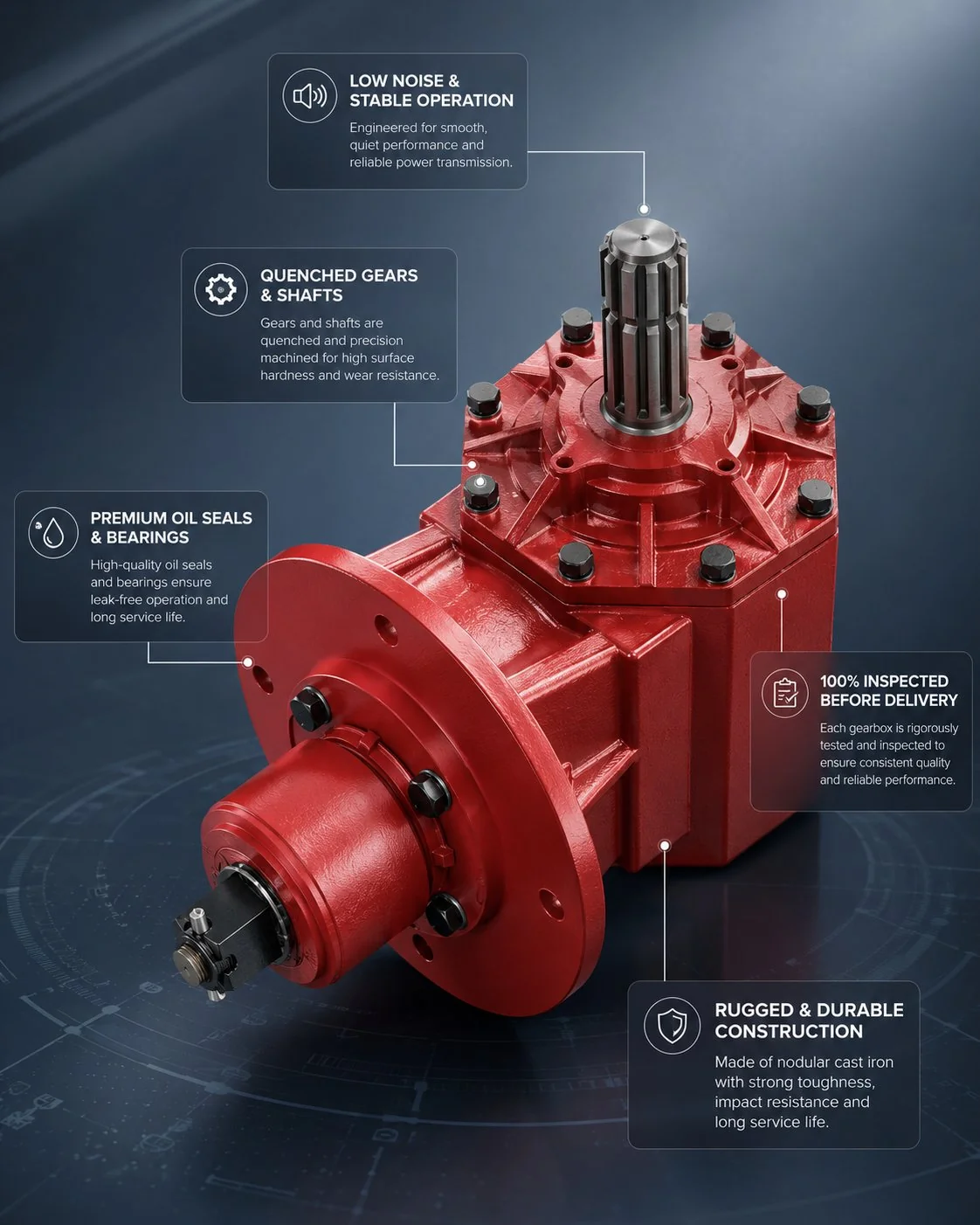
Boîtier symétrique GGG50
Le carter présente une symétrie bilatérale par rapport à l'axe d'entrée de la prise de force : épaisseur de paroi identique, positionnement identique des alésages de paliers et géométrie des nervures identique des deux côtés de l'arbre de sortie. Cette symétrie n'est pas qu'esthétique : une rigidité asymétrique du carter sous charge engendrerait des déformations différentes au niveau des zones de contact des engrenages gauche et droit, provoquant à terme une usure inégale des dents de la roue d'entrée commune. La conception symétrique du carter élimine ce risque de défaillance dès sa conception.
Engrenages coniques trempés M6.0
L'engrenage conique 20/20 de module 6,0 est cémenté sur une profondeur de 0,8 à 1,2 mm et trempé à une dureté Rockwell C de 58 à 62. Avec un rapport de 1:1 entraînant simultanément deux sorties, la roue d'entrée supporte le couple combiné des deux disques avant de le répartir. La section de denture M6,0 assure la résistance à la flexion à la base pour cette charge combinée, tandis que la disposition symétrique des 20 dents de chaque côté de la sortie évite la concentration de la charge sur un seul flanc.
Sorties de puits à double joint résistantes aux engrais
Les épandeurs d'engrais fonctionnent dans un environnement agressif : le nitrate d'ammonium, l'urée, le chlorure de potassium et les granulés NPK composés produisent tous une poussière hygroscopique qui s'infiltre dans les interstices de la machinerie et se dissout en une boue corrosive en présence d'humidité. Les sorties de l'arbre de sortie de l'EP-AG135 sont équipées de joints NBR à double lèvre et d'une lèvre supplémentaire anti-poussière, offrant ainsi une protection à trois couches sur les deux arbres de sortie et empêchant les résidus d'engrais d'atteindre les bagues de roulement pendant l'épandage.
Traitement de surface résistant à la corrosion
La surface externe du carter est traitée avec un revêtement anticorrosion compatible avec l'environnement des engrais. Les engrais granulés qui entrent en contact avec le carter lors du remplissage ou de l'épandage ne provoquent pas de corrosion superficielle accélérée susceptible de compromettre son intégrité. Les arbres de sortie cannelés à base conique sont fabriqués en acier allié cémenté, avec une finition de surface adaptée à l'environnement corrosif des poussières d'engrais lors du montage et du démontage du moyeu à disques.
Sortie à cannelures à base conique — Moyeux à disque autocentrants
Le filetage conique à cannelure équidistante des deux sorties est la norme du secteur pour la fixation des moyeux de disques des épandeurs à double disque. L'engagement conique assure un autocentrage du moyeu lors du montage, garantissant une concentricité constante entre la face du disque et l'axe de l'arbre à chaque démontage et remontage. Ceci est crucial pour le calibrage de l'épandeur : un disque décentré modifie le rayon de portée effectif et invalide la courbe d'épandage sans produire de bruit ni de vibration perceptible.
Test de charge — Les deux sorties simultanément
Chaque EP-AG135 est testé en laboratoire à pleine charge nominale de 50 CV avec les deux Les arbres de sortie sont chargés simultanément, et non séquentiellement. Un essai ne chargeant qu'une seule sortie à la fois ne permet pas de vérifier la rigidité du carter ni l'état d'engrènement dans les conditions réelles de double charge symétrique, lors du fonctionnement de l'épandeur. L'essai de charge simultanée confirme le profil de contact des engrenages, la température des paliers et l'intégrité des joints d'huile dans les conditions auxquelles l'unité sera soumise en service.
Où l'EP-AG135 est utilisé
🌾 Application d'engrais granulés — Exploitations céréalières et maraîchères coréennes
Dans les régions céréalières de Corée du Sud (riz à Jeolla et Chungnam, orge et blé à Gyeongbuk, et maïs à Gangwon), un engrais de fond (généralement un engrais composé NPK 20-20-0 ou 16-16-16) est appliqué au moment des semis de printemps à l'aide d'épandeurs à double disque montés sur des tracteurs compacts et utilitaires de 45 à 55 ch. La boîte de vitesses EP-AG135 équipe les épandeurs d'origine sud-coréenne commercialisés sur ce marché : avec une puissance de 50 ch et un régime de 540 tr/min, elle offre une puissance équivalente à celle de la prise de force des principaux modèles de tracteurs coréens (Daedong DK, LS MT, TYM T403) tout en assurant une transmission synchrone à double disque, évitant ainsi les asymétries d'épandage constatées lors des analyses de sol et des cartographies de rendement ultérieures.
🍚 Fertilisation des rizières — Japon et Vietnam
Au Japon, dans les préfectures de Niigata, d'Akita et de Yamagata, la riziculture utilise la fertilisation de couverture, consistant à appliquer de l'azote au stade du tallage à l'aide d'épandeurs pneumatiques et d'épandeurs à double disque sur les digues et les zones surélevées adjacentes. L'épandeur EP-AG135 est utilisé sur les systèmes d'épandage au sol opérant sur les chemins surélevés entre les parcelles de rizière. Sa puissance de 50 ch et son poids compact de 16,5 kg permettent de l'installer sur des tracteurs compacts capables de manœuvrer dans des virages étroits. Dans le delta du Mékong, au Vietnam, les riziculteurs privilégient de plus en plus les épandeurs à double disque pour la fertilisation des rizières, délaissant ainsi la méthode traditionnelle d'épandage manuel. L'EP-AG135 est adapté aux tracteurs chinois et coréens de 40 à 55 ch disponibles localement.
🌴 Fertilisation des cultures de plantation — Asie du Sud-Est
En Malaisie, en Indonésie et en Thaïlande, les plantations de palmiers à huile, d'hévéas et de canne à sucre épandent d'importantes quantités d'engrais granulés (généralement 200 à 400 kg/ha par cycle d'application) sur les cultures établies à l'aide d'épandeurs à double disque. Ces exploitations utilisent des épandeurs grand format montés sur des tracteurs de 60 à 80 ch, mais la puissance de 50 ch de l'EP-AG135 couvre la majorité des combinaisons tracteur-épandeur utilisées dans les plantations de plus petite taille et pour les services d'épandage à façon. L'entraînement synchrone des disques est particulièrement apprécié car l'épandage d'engrais est souvent réalisé rapidement, à des stades critiques de croissance des cultures, ne permettant aucun passage supplémentaire pour corriger une répartition asymétrique.
🏭 Fabricant d'épandeurs d'engrais OEM — Corée et Japon
Les fabricants coréens de machines agricoles des provinces de Gyeongsang du Sud et de Gyeonggi produisent des épandeurs d'engrais à double disque destinés au marché intérieur et à l'exportation vers l'Asie du Sud-Est, le Moyen-Orient et l'Europe de l'Est. La boîte de vitesses EP-AG135 est la norme pour les clients OEM de Korea Ever-Power dans ce secteur, car ses sorties cannelées à base conique sont compatibles avec les moyeux de disques des épandeurs européens qui servent de référence pour la conception des machines coréennes. Korea Ever-Power fournit à ses clients OEM une certification dimensionnelle, une qualité de lot constante et un stock dédié. Contactez notre équipe technico-commerciale pour plus d'informations sur notre programme OEM.
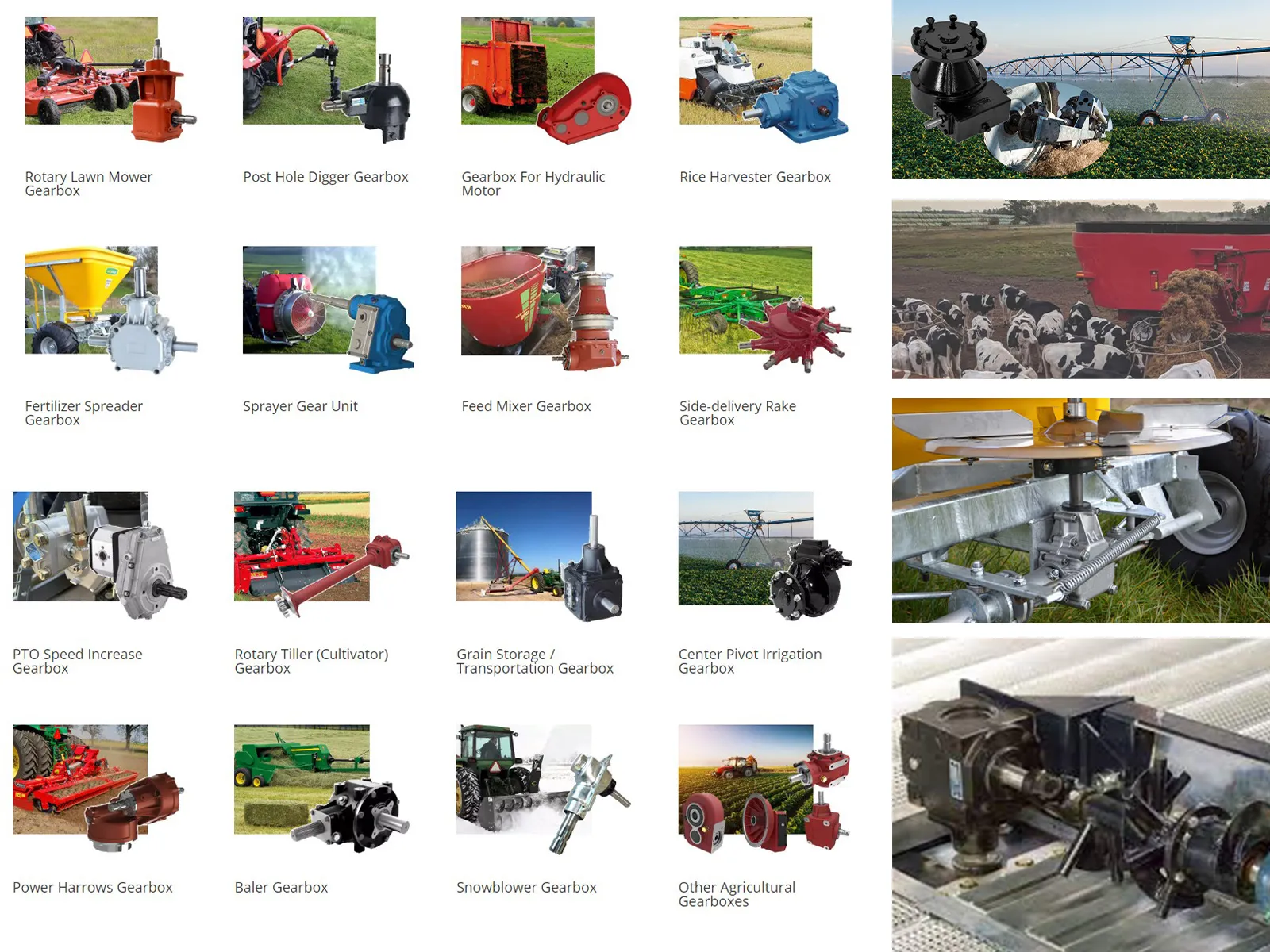
Entretien de la boîte de vitesses d'un épandeur d'engrais — Considérations particulières
Les boîtes de vitesses des épandeurs d'engrais fonctionnent dans un environnement particulièrement agressif, contrairement à celles des tondeuses et des motoculteurs : la poussière d'engrais hygroscopique, les lavages répétés à l'eau et le contact chimique avec les composés d'ammonium et de nitrate accélèrent l'usure et la corrosion si le programme d'entretien n'en tient pas compte. Les pratiques suivantes s'appliquent spécifiquement à l'épandeur EP-AG135 :
Après chaque utilisation :Démontez les moyeux de disque et nettoyez à l'eau claire les résidus d'engrais présents sur la cannelure de l'arbre de sortie. Séchez soigneusement avant le rangement ; veillez à ne laisser aucun résidu d'engrais sur la cannelure du cône, car les sels d'engrais accélèrent la corrosion de contact. Appliquez une fine couche de pâte anti-grippage sur la cannelure avant de remonter les moyeux.
Contrôle du niveau d'huile (toutes les 50 heures ou en début de saison) :Vérifiez le niveau et la couleur de l'huile d'engrenage. Une huile laiteuse ou liquide indique une infiltration d'eau par un joint défectueux ; ce risque est particulièrement important lors de l'utilisation d'un épandeur, car l'eau de lavage peut être dirigée directement sur les lèvres du joint. Remplacez immédiatement les joints en cas de contamination par l'eau ; une utilisation prolongée de quelques heures avec une huile d'engrenage contaminée par l'eau provoque une corrosion irréversible des roulements.
Stockage saisonnier :Avant l'hivernage, vidangez l'huile de boîte de vitesses et remplacez-la par de l'huile neuve SAE 90 GL-4. Cela permet d'éliminer les produits de dégradation acides issus de l'épandage d'engrais. Nettoyez soigneusement toutes les surfaces externes, retirez les moyeux à disques et entreposez la boîte de vitesses dans un endroit sec et abrité. Une légère pulvérisation d'inhibiteur de rouille hydrofuge sur les cannelures de sortie pendant l'hivernage prévient l'oxydation superficielle qui rend le démontage des moyeux à disques difficile au début de la saison suivante.
Avertissement:Ne jamais nettoyer le carter de boîte de vitesses au nettoyeur haute pression lorsque les moyeux de disque sont démontés : l’eau à haute pression dirigée vers les lèvres du joint d’étanchéité de l’arbre de sortie peut faire pénétrer de l’eau au-delà de ces lèvres et dans le roulement. Laver à la main avec de l’eau à basse pression et une brosse, ou utiliser uniquement le système de lavage basse pression du tracteur.
Pourquoi les fabricants d'épandeurs d'engrais choisissent la Corée Ever-Power
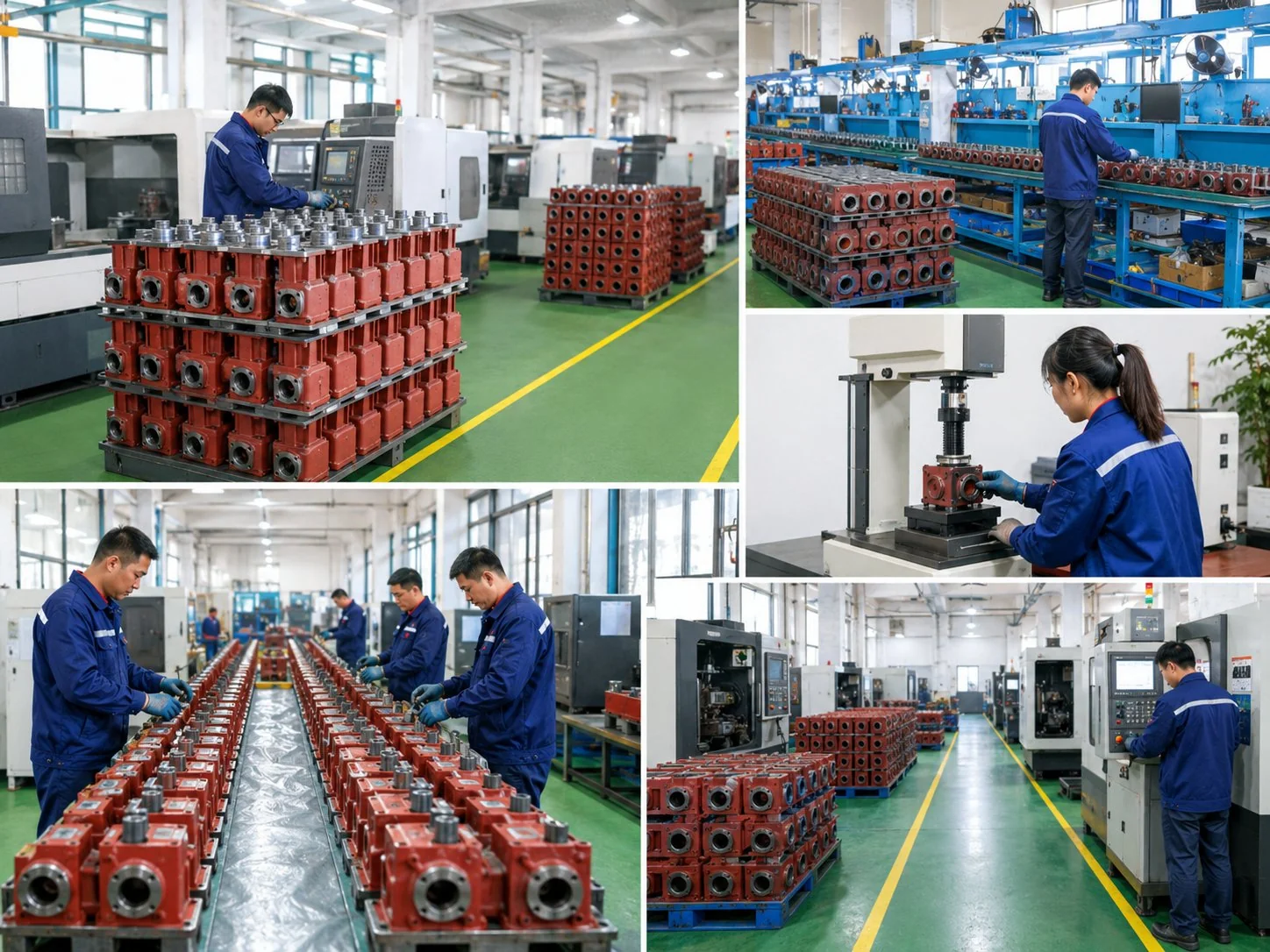
Production de logements symétriques — usinage CNC bilatéral pour une géométrie de sortie égale
La fabrication du carter symétrique à double sortie de l'EP-AG135 nécessite l'usinage des deux alésages de palier de l'arbre de sortie en une seule opération de serrage — le seul moyen de garantir un alignement égal des alésages par rapport à l'axe de l'arbre d'entrée. Korea Ever-Power Agricultural Machinery Co., Ltd.Les capacités d'usinage CNC de l'entreprise incluent le montage multiaxes nécessaire à cette opération pour toute la gamme de boîtiers de la série HC. Il ne s'agit pas d'une adaptation de processus ; c'est une étape de production intégrée au flux de fabrication de l'EP-AG135 depuis le lancement du produit.
Pour les fabricants coréens d'épandeurs d'engrais et les distributeurs de machines agricoles d'Asie du Sud-Est, Korea Ever-Power assure une livraison sous 3 à 7 jours ouvrés grâce à son stock régional, un délai nettement inférieur aux 6 à 10 semaines nécessaires pour les pièces de rechange d'origine européenne équivalentes. La documentation d'exportation complète fournie pour chaque envoi facilite le dédouanement dans le cadre du RCEP et des accords tarifaires préférentiels de l'ASEAN.
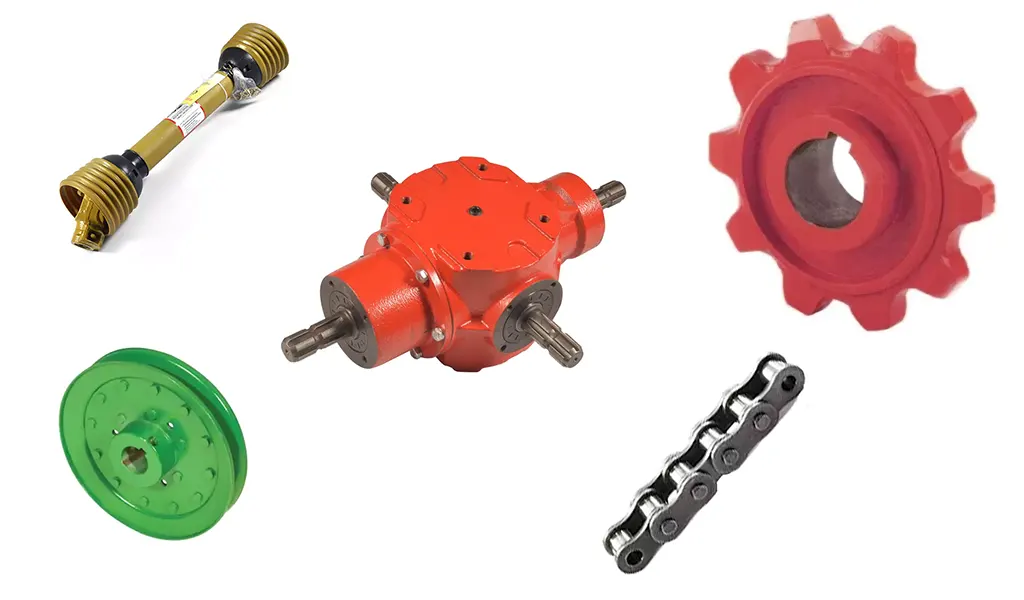
Produits connexes et composants d'entraînement
Ce que les clients disent de l'EP-AG135
Foire aux questions — EP-AG135
Informations complémentaires
| Éditeur | Cxm |
|---|
Produits similaires
-
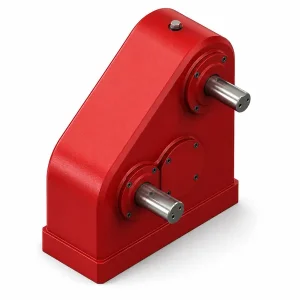
Réducteur EP-FRM70 pour la récupération de films résiduels — 40 à 70 kW, réduction et augmentation de vitesse à double mode
-
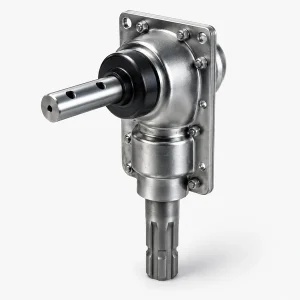
Réducteur en aluminium EP-01-229 et réducteur à engrenages coniques à trois arbres EP-1ZS-380 – Série pour applications spéciales
-
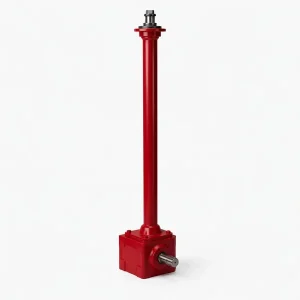
Réducteur agricole EP20100.131.00 – 100 CV, réduction 13:1, 600 tr/min, bride à 8 boulons
-
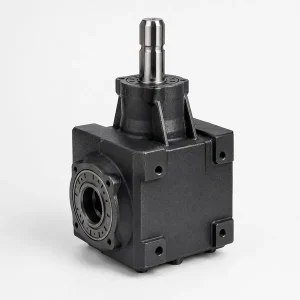
Réducteur EP01-672 pour presse à balles – 50 CV, double rapport de réduction 1,92:1 et 1,47:1
-
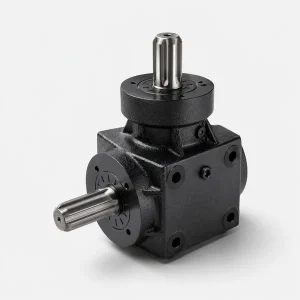
Boîte de vitesses pour presse à balles rondes légères EP-BGB8 – 30 CV, deux rapports
-
Réducteur de broche de tondeuse à arbre vertical EP-MDH – MDH-40 (bride carrée) et MDH-65 (bride hexagonale)
-
Réducteur d'angle EP-HC 68° – 30 CV, angle d'arbre de 68°, rapport de prise de force 1:1
-
Boîte de vitesses pour presse à balles rondes EP-HC-40002 – 85 CV, usage intensif